
How Do You Choose the Right Gate Operator for the Size and Weight of Your Gate?
How Do You Choose the Right Gate Operator for the Size and Weight of Your Gate?
Bigger Doesn’t Always Mean Stronger—and the Wrong Gate Operator Can Cost You Thousands
When designing an automatic gate system, one of the most important decisions happens before the gate operator is ever installed.
How much does your gate actually weigh, what is it made from, and how much force will be required to move it safely and reliably?
After nearly 17 years working professionally in gate automation and access control, I have seen firsthand what happens when these questions aren’t addressed during the design process.
There are dozens of gate operator manufacturers and many different styles of automatic gate operators available for residential, commercial, industrial, and community applications. The correct operator should not be selected simply because someone says, “This operator will move a gate this size.”
The entire system needs to be considered.
That starts with the gate itself.
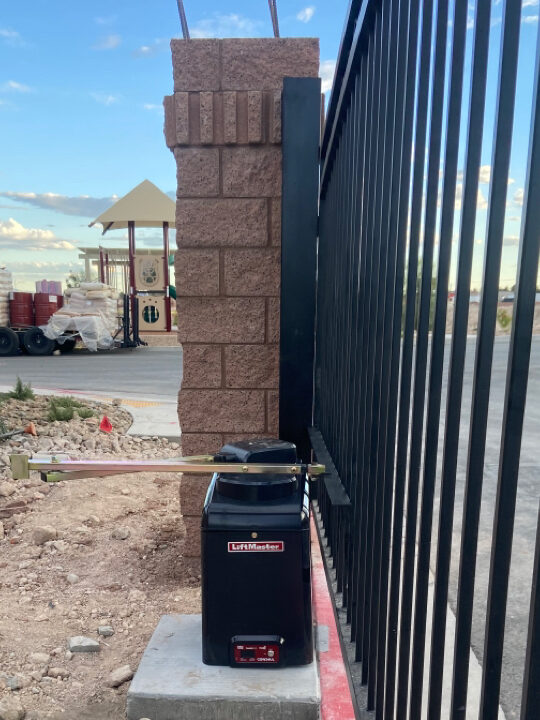
Bigger Steel Doesn’t Always Mean a Stronger Gate
One misconception I frequently encounter is that larger square tubing automatically means a stronger gate.
That isn’t necessarily true.
For example, someone designing a gate may request a 3″ x 3″ steel frame because it looks large, substantial, and strong. But the outside dimensions of the tubing only tell you part of the story.
The wall thickness of the steel is extremely important.
A 3″ x 3″ tube manufactured from approximately 0.065″ wall material may look significantly larger than a 2″ x 2″ tube manufactured with a 0.120″ wall thickness, but that doesn’t automatically make the larger tubing the better structural choice.
The smaller tubing has substantially thicker walls.
That is why professional gate design shouldn’t be based on appearance alone.
Gate dimensions, wall thickness, gate design, span, bracing, infill material, weld locations, expected loading, and overall weight all need to be considered.
The objective should be to build a gate with the strength and structural integrity necessary for the application without adding unnecessary weight.
Why Does Gate Weight Matter?
Because everything supporting and moving that gate has to deal with that weight—every single time the gate cycles.
The heavier the gate becomes, the more consideration must be given to:
- Hinges and bearing points
- Hinge posts and structural supports
- Concrete footings and foundations
- Gate frames and welds
- Operator mounting locations
- Operator arms and hardware
- The gate operator itself
- Expected daily cycle count
- Wind resistance
I have encountered gates during my career constructed from 2-inch square tubing with 1/4-inch wall thickness.
For comparison, 1/4-inch material is approximately 0.250 inches thick.
That is extremely substantial material.
There may absolutely be applications where a gate of that construction is appropriate. But all that additional steel also means additional weight.
Now your hinges have to support it.
Your hinge post has to support it.
Your footing has to support it.
And if you’re automating that gate, your gate operator has to move it thousands upon thousands of times.
That’s where proper planning becomes critical.
Your Gate Operator Needs to Match the Application—not Just the Gate
There is nothing wrong with wanting a large, substantial entrance gate.
A heavy steel gate can provide security, durability, and the appearance many residential communities and commercial facilities want.
But if you plan on automating it, your gate automation contractor needs to be involved in the conversation.
Gate operators are available in an enormous range of sizes and capabilities. We have worked with everything from standard residential and commercial operators to extremely heavy-duty systems capable of moving gates weighing thousands of pounds.
The important part is matching the operator to the actual application.
Simply looking at the manufacturer’s maximum gate-weight rating isn’t enough.
A professional should consider the gate’s:
Weight + Length + Height + Construction + Geometry + Cycle Count + Wind Exposure + Application
All of those factors contribute to selecting and designing the appropriate automation system.
What Happens When an Operator Is Too Small for the Gate?
An undersized operator may work perfectly when it is first installed.
That’s part of what makes this problem difficult for property owners to recognize.
The gate opens.
The gate closes.
Everything appears to work.
But operating successfully a few times during installation isn’t the same thing as operating reliably for years.
An operator working near its maximum capability can experience significantly greater stress over thousands of cycles. Add poor mounting geometry, a heavy gate, worn hinges, resistance in the gate movement, or high winds, and the operator has to work even harder.
Over time, that can contribute to premature component wear, faults, unreliable operation, and ultimately a shorter service life.
The goal should never be to install an operator that can barely move the gate.
The goal should be to design a system with an appropriate operating margin for the conditions it will actually experience.
Don’t Forget About Wind
This is particularly important in areas like Las Vegas and Southern Nevada, where high winds can dramatically change the forces acting on a gate.
Consider a large swing gate.
On a calm day, the operator primarily has to overcome the mechanical forces associated with moving the gate.
Now put decorative sheet metal, privacy screening, closely spaced pickets, wood, composite panels, or another relatively solid material across that same gate.
Suddenly, you have created something very similar to a giant sail.
When strong wind pushes against that surface while the operator is attempting to open or close the gate, the forces involved can be dramatically different from those experienced on a calm day.
This is why gate weight alone doesn’t tell the entire story.
A gate that weighs 1,000 pounds in calm weather still weighs 1,000 pounds—but the operator may be fighting substantial additional wind force while trying to move it.
An experienced gate automation contractor should consider that when designing the system.
In some applications, that means selecting a more robust operator.
In others, it may mean changing the gate design, reducing wind-catching surface area, modifying the automation geometry, strengthening supporting components, or using a completely different style of operator.
Gate Fabrication and Gate Automation Should Work Together
One of the best things you can do when designing a new automated entrance is have your gate fabricator and gate automation contractor coordinate before fabrication begins.
This is especially important for large HOA, multifamily, commercial, and industrial gates.
Your automation contractor should know what is being built:
How long is each gate leaf?
How tall is it?
What size and wall thickness is the steel?
What type of infill will be installed?
What is the estimated finished weight?
How will the gate be supported?
How frequently will it operate?
What are the expected wind conditions?
With that information, the automation system can be designed around the actual gate rather than trying to make an operator work with whatever arrives at the jobsite.
Build the Gate You Want—Just Automate It Correctly
This article isn’t intended to discourage anyone from building a large or heavy gate.
If you want a substantial steel entrance gate for your residence, commercial facility, apartment community, or HOA, there are automation systems available for extremely demanding applications.
The key is planning for it.
If your gate is going to weigh thousands of pounds, tell your automation contractor before it is fabricated.
If it is going to be covered with material that catches significant wind, tell them.
If the gate will cycle hundreds of times per day, that matters too.
Your gate, hinges, posts, foundations, operator, controls, and safety equipment should ultimately function as one complete system.
The Question to Ask Before Installing an Automatic Gate
Before choosing a gate operator, don’t simply ask:
“How much weight can this operator move?”
Ask:
“Is this the correct operator for my specific gate, its construction, its daily use, its geometry, and the conditions it will operate in?”
Those are two very different questions.
A properly designed automatic gate system should not merely work on the day it is installed. It should be engineered to provide dependable operation for years to come.
At Battle Born Access Systems, we specialize in gate automation, access control, new construction, system rehabilitation, and complete gate rebuilds for commercial properties, residential communities, HOAs, and other facilities throughout Las Vegas and Southern Nevada.
If you’re planning a new automated gate system, involve your automation professional early in the design process.
Build the gate you want—but make sure the entire system is designed to handle it.